

How to Wrap a Painting as a Gift?
Gifting a painting is no easy task, especially when you want to make a good impression and truly delight the recipient. You want to subtly make your gift stand out from the rest, not by its financial value, but by its thoughtfulness; to be appreciated as a piece of art and spiritual value; for the gesture to be remembered and received as something very personal and meaningful.
Gifting a painting is definitely a commitment, both physically — choosing the artist, subject, technique, size, color scheme, etc. — and psychologically. How much does art play a part in the recipient's life? Is there space for it at home or in the office, and will it fit into the existing decor? Do you know their taste well enough, and how will your gift be perceived — does it include or exclude you from their close circle? These are just some of the questions to answer before you step into a gallery or an art store.
If you've passed this test and are ready to carry out your idea, start by familiarizing yourself with the art market near you. The internet can be a good assistant in gathering comprehensive information. While the selection is vast, my first tip is: look for young, talented, and enterprising artists who are focused on the gift niche. Why? Because they have a concept for creating paintings as gifts with a variety of styles, sizes, subjects, and colors — and importantly, they often offer packaging options too. They quickly understand what you need and can advise you on how best to achieve your goal.
If you've decided to give a painting as a gift, it’s always a good idea to see it "in person" first, not just through a photo online. Visually absorb the size, immerse yourself in the color palette, and make sure of the artist’s talent and skills before making your final choice.
Once that's done, here's my second important tip — how to wrap the painting to present it in the best possible way.
Types of Painting Wrapping
There are all kinds of packaging options — from polyethylene bags to paper, textile, and other materials in various shapes. All of these are fine for standard gifts like consumables, food, or otherwise. But for a work of art, you need special packaging that hints the gift is out of the ordinary, with a playful surprise and personal touch.
Wrapping a Painting in a Gift Box and Ribbon
You can choose to wrap the painting in a gift box made of glossy or matte cardboard, in which the painting can be placed. The color is according to what's available in the market, and when possible, it’s best to choose a color favored by the person receiving the painting. You can find many companies online offering gift boxes and packaging materials — browse their offerings and make your selection. Always ensure the box is at least 1 cm larger than the painting's dimensions — with or without a frame. The painting should fit comfortably in the box, without being forced in or difficult to remove and place back.
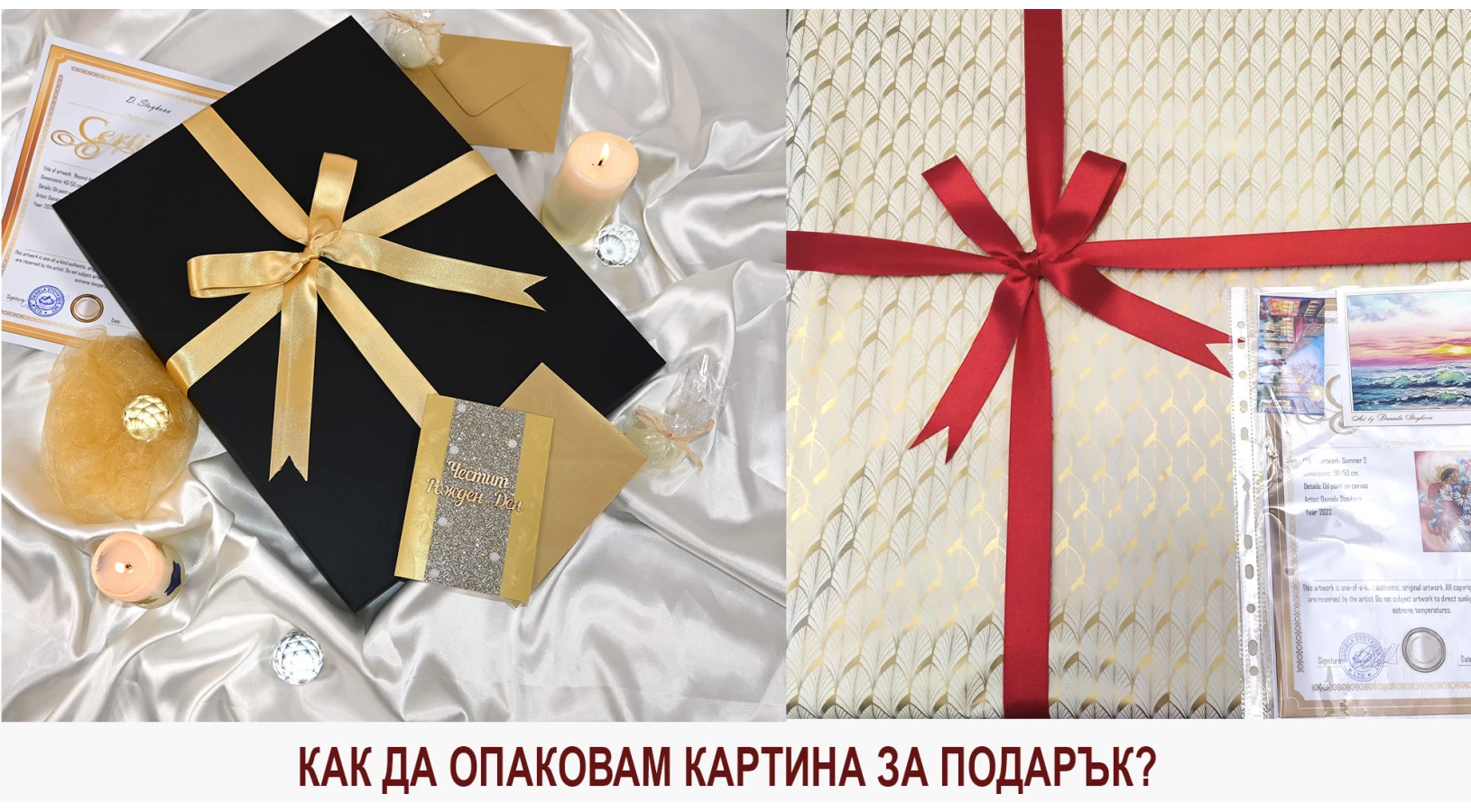
At Art Gallery "Daniela Stoykova," we offer gift boxes for our clients, handmade from black cardboard and lined with stiff material for durability. This is because the paintings we offer come in a variety of sizes, making it difficult to find mass-produced, pre-cut boxes for all the different dimensions.
It's advisable not to place the painting directly in the box but to prepare a cozy “bed” for it, using decorative straw or gift filler in a color of your choice, or wrap it in soft, delicate tissue paper. When you've chosen a hand-painted work, it’s a good idea to obtain an authenticity certificate to place under the painting in the box. On top of the tissue paper, place a greeting card with your personal message.
Finally, close the box with its lid and tie it with a beautiful, colorful ribbon. You can find a wide selection of ribbons in different colors and widths in craft or flower shops. When wrapped this way, your gift will have not only measurable financial value but also personal, sentimental, and irreplaceable worth — a lasting memory of you for years to come…

Wrapping a Painting with Colored Cellophane and Ribbon
A second option for wrapping the painting yourself is to wrap it in printed cellophane (foil) of your choice or other colorful wrapping paper, which you can purchase at large supermarkets or smaller flower shops.
You can gently fold and tape the loose sides of the paper around the painting, or to make it look more professional, we advise using double-sided tape. Stick it to the edge of the cellophane or paper on the underside, so the two parts adhere without visible tape showing.
Finally, tie it again with a beautiful, colorful ribbon of your choice, and underneath it, place your greeting card. Don’t forget to also include the authenticity certificate beneath the ribbon.
Wrapping a Painting with Just a Ribbon
A third option, for larger paintings, is to tie a satin ribbon in a suitable color around the painting, or use a pre-made ribbon from a flower shop. This way, the painting remains visible, but at the same time, is wrapped as a gift, and the ribbon adds a sense of festivity.
Wrapping a Painting for Shipping
Wrapping for shipping with courier companies, postal services, or other transporters is entirely different from gift wrapping. The goal is for the painting to arrive safely at its destination, not to look pretty.
If you’re choosing a painting from an online store, it’s a good idea to inquire in advance about their shipping methods with courier companies or postal services. At "Daniela Stoykova" Gallery, we offer reliable, secure packaging for transport via personal delivery, air, land, or sea, using a cardboard box for sturdiness along with bubble wrap. More details on how we do this will be revealed in another article.
How to Wrap Paintings as Gifts: A Practical Guide and More Tips
Measure the painting. Before you start wrapping, make sure you have accurately measured the painting’s dimensions. This will help you choose appropriate wrapping paper or cellophane and avoid unnecessary excess material or a shortage. One roll of wrapping paper might not be enough for a larger painting.
- Protect the surface with soft wrapping, if necessary. If the painting you’re wrapping is not an oil painting on canvas, but for example, watercolor or another medium with a glass front, it’s a good idea to use bubble wrap or soft fabric for protection. This can also be done to protect the frame of an oil or other painting from scratches or chips. Carefully wrap the entire painting, paying special attention to the corners and edges of the frame, which are most vulnerable to damage.
- Choose stylish wrapping paper. Once you’ve protected the painting from damage, it’s time to cover it with wrapping paper or fabric. Choose a paper that complements the painting or suits the occasion for which the gift is intended. For more formal occasions, you may want to use luxury paper or cellophane with metallic gold elements.
- Wrap the painting in the paper. Place the painting face down on the wrapping paper or fabric. Leave enough paper on all sides to fold over the edges of the painting. It looks neater if the edges are taped along the sides of the painting, or if you use double-sided tape, as mentioned earlier.
- Decorate with a satin ribbon tied in a bow or a pre-made gift ribbon. A beautiful ribbon adds extra elegance.
- Place the painting in a box (optional). You can place the painting in a box and tie it with a ribbon, as described above. If you want to provide extra protection or prefer a more luxurious look, place the painting in a box. Choose a box that’s not too large, so the painting doesn’t shift inside. You may add a layer of soft gift filler for added security.
- Add a personal touch. One of the best ways to personalize the gift is to add something personal. You can attach a small card with a handwritten message or include a brief story about the painting and its significance.
Wrapping a painting as a gift requires attention to detail and the right choice of materials. By following these steps, you'll ensure not only the safety of the gift but also create an elegant and memorable effect that highlights the uniqueness of the artwork.


Leave a Comment